- Sumário
- Relato de Richard Twiss sobre o teatro português
- Ano
- s.a.
- Comentário
As referências de Laureano Carreira são pela tradução em francês, Voyage en Portugal et en Espagne, fait en 1772 et 1773, Berne, Société Typographique, 1776
- Impresso
- Richard Twiss, Travels through Portugal and Spain, in 1772 and 1773, London, G. Robinson, T. Becket & J. Robson 1775: pp. 2-3; 10-12
- Menções
- Laureano Carreira 1988: 393-394; 1988: 391-392: Rui Vieira Nery
TWISS, Richard
TRAVELS / THROUGH / PORTUGAL and SPAIN, / IN 1772 AND 1773. / BY / RICHARD TWISS, ESQ. F.R.S. / WITH COPPER-PLATES; / AND / AN APPENDIX.
London: Impresso para o Autor e vendido por G. Robinson, T. Becket & J. Robson, 1775.
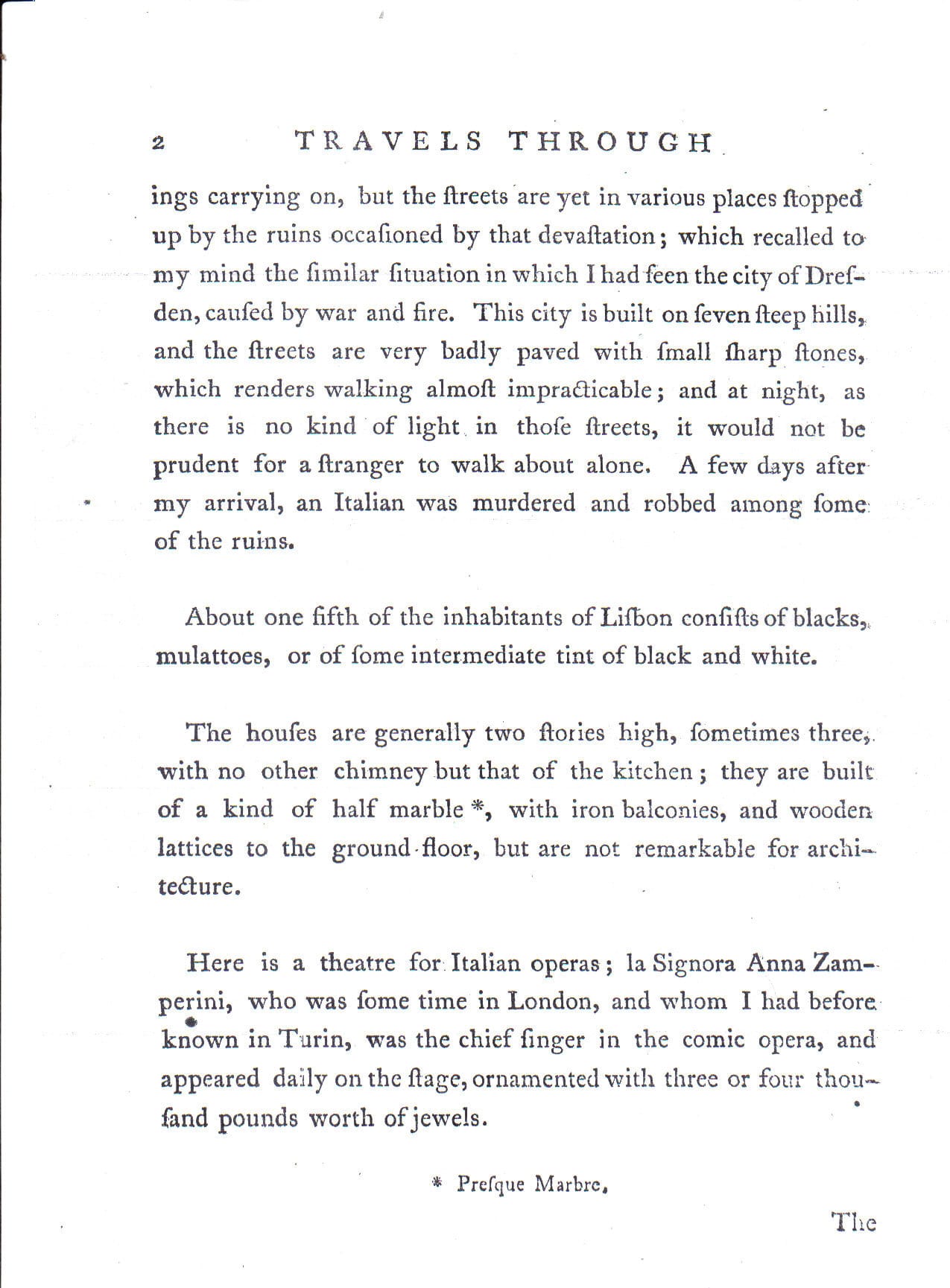
Here is a theatre for Italian operas; la Signora Anna Zamperini, who was some time in London, and whom I had before known in Turin, was the chief singer in the comic opera, and appeared daily on stage, ornamented with three or four thousand pounds worth of jewels.
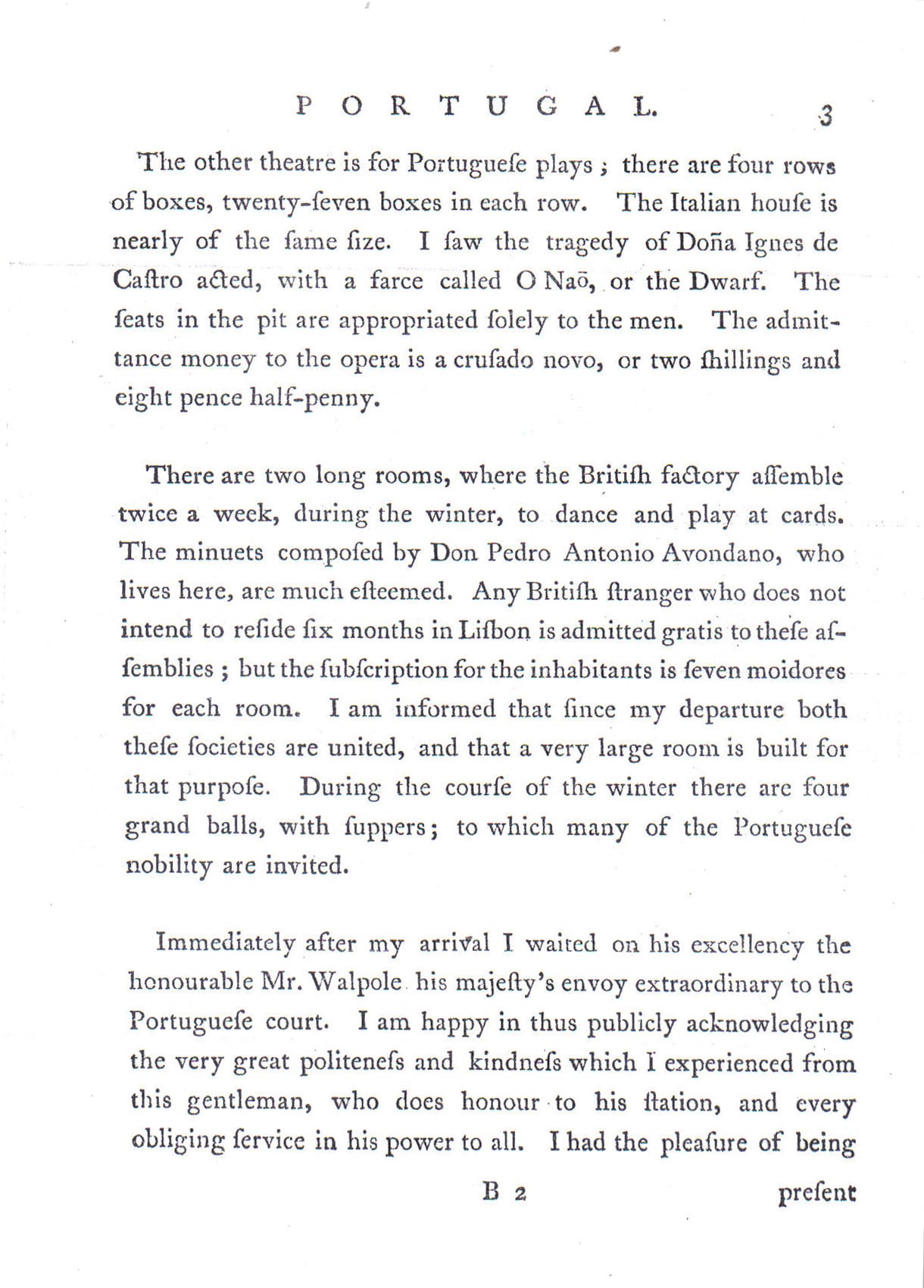
The other theatre is for Portuguese plays; there are four rows of boxes, twenty-seven boxes in each row. The Italian house is nearly of the same size. I saw the tragedy of Doña Ignes de Castro acted, with a farce called o Naõ, or the Dwarf. The seats in the pit are appropriated solely to the men. The admittance money to the opera is a crusado novo, or two shillings and eight pence half-penny.
There are two long rooms, where the British factory assemble twice a week, during the winter, to dance and play at cards. The minuets composed by Don Pedro Antonio Avondano, who lives here, are much estemed. Any British stranger who does not intend to reside six months in Lisbon is admitted gratis to these assemblies; but the subscription for the inhabitants is seven moidores for each room. I am informed that since my departure both these societies are united, and that a very large room is built for that purpose. During the course of the winter there are four grand balls, with suppers; to which many of the Portuguese nobility are invited. [...]
[...]
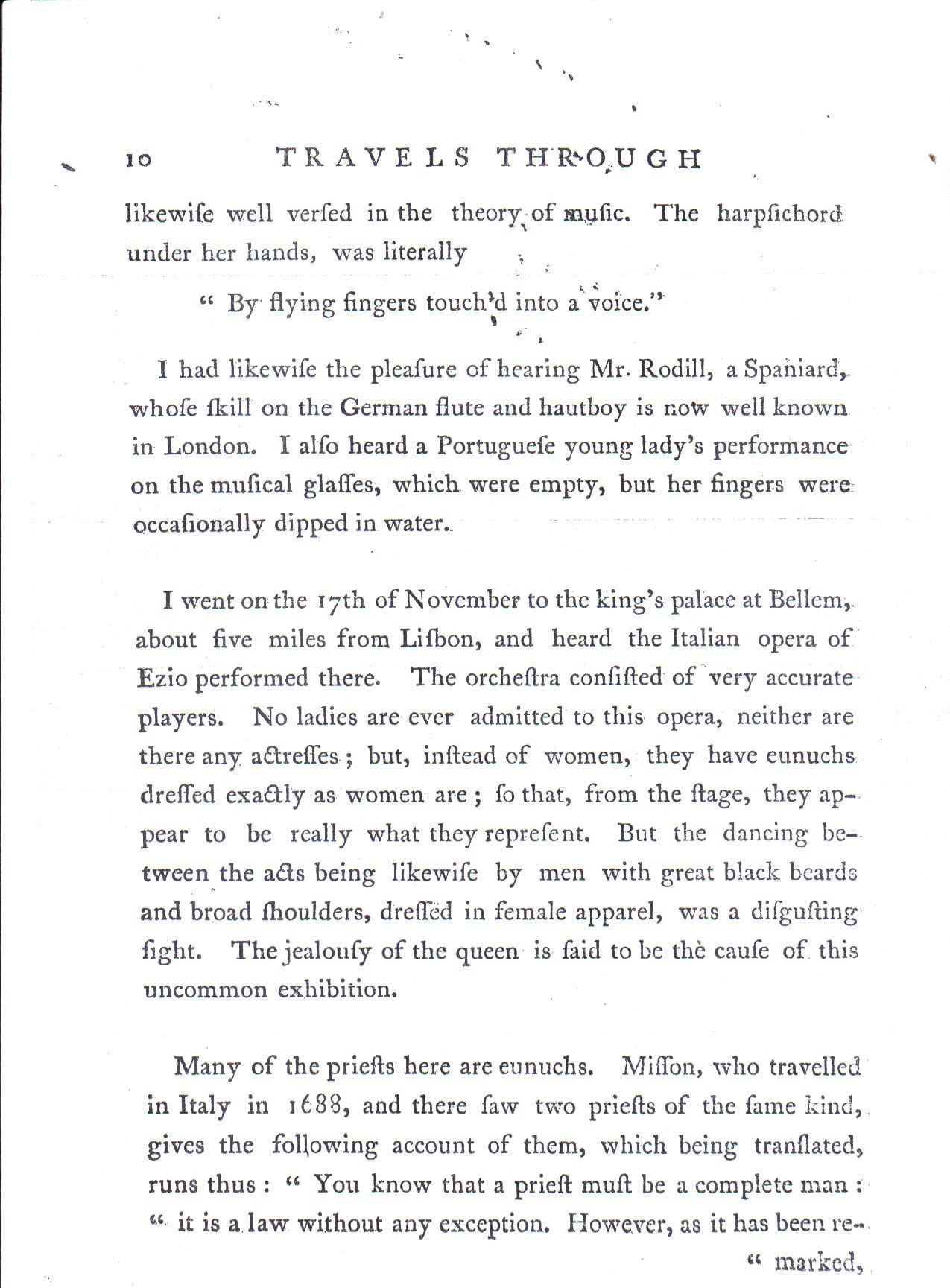
I went on the 17th of November to the king's palace at Bellem, about five miles from Lisbon, and heard the Italian opera of Ezio performed there. The orchestra consisted of very accurate players. No ladies are ever admitted to this opera, neither are there any actresses; but, instead of women, they have eunuchs dressed exactly as women are; so that, from the stage, they appear to be really what they represent. But the dancing between the acts being likewise by men with great black beards and broad shoulders, dressed in female apparel, was a disgusting sight. The jealousy of the queen is said to be the cause of this uncommon exhibition.
Many of the priests here are eunuchs. Misson, who travelled in Italy in 1688, and there saw two priests of the same kind, gives the following account of them, which being translated, runs thus; "You know that a priest must be a complete man: it is a law without any exception. However, as it has been
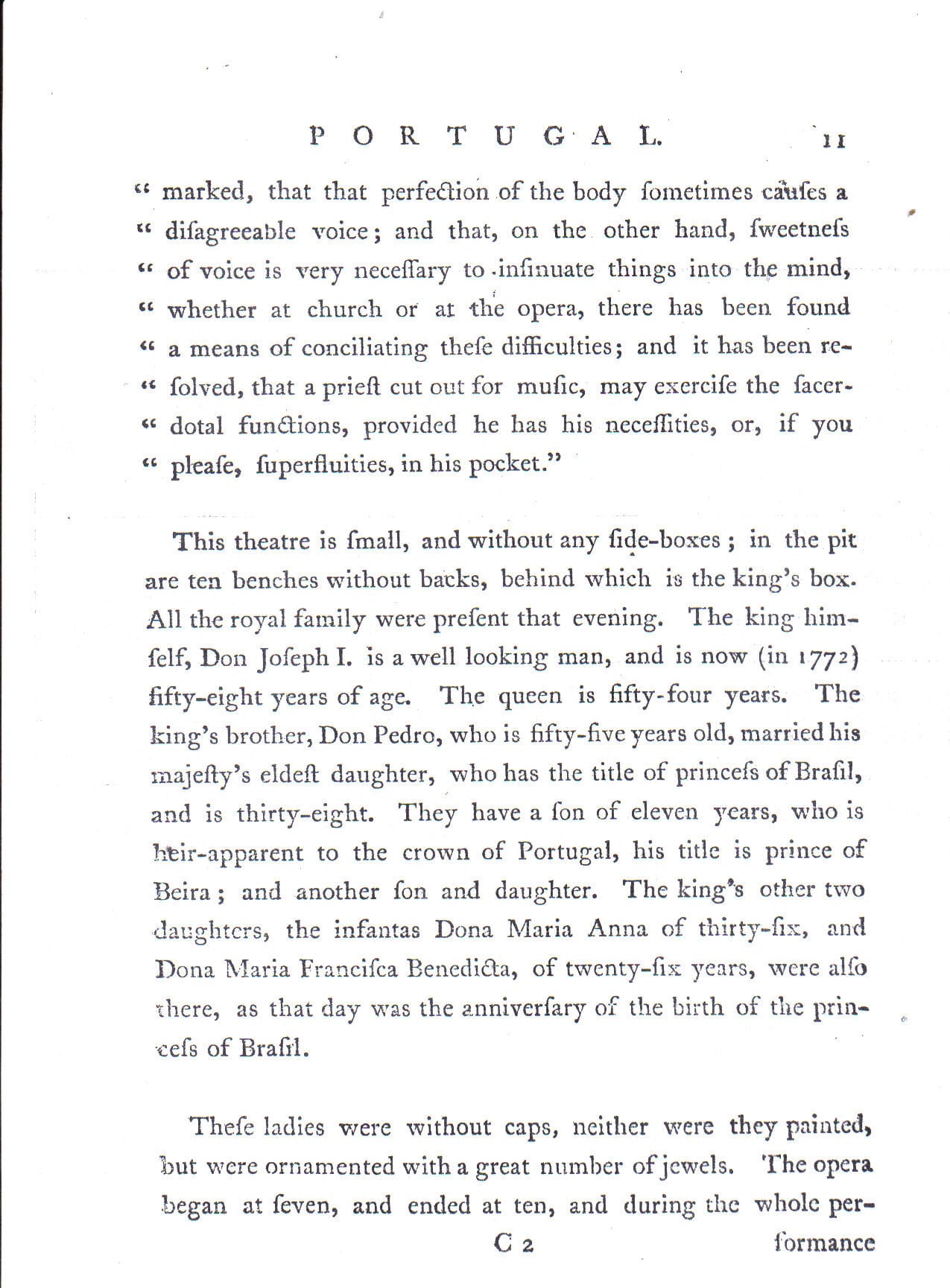
remarked, that that perfection of the body sometimes causes a disagreeable voice; and that, on the other hand, sweetness of voice is very necessary to insinuate things into the mind, whether at church or at the opera, there has been found a means of conciliating these dificulties; and it has been resolved, that a priest cut out for music, may exercise the sacerdotal function, provided he has his necessities, or, if you please, superfluities, in his pocket."
The theatre is small, and without any side-boxes, in the pit are ten benches without backs, behind which is the king's box. All the royal family were present that evening. The king himself, Don Joseph I. is a well looking man, and is now (in 1772) fifty-eight years of age. The queen is fifty-four years. The king's brother, Don Pedro, who is fifty-five years old, married his majesty's eldest daughter, who has the title of princess of Brasil, and is thirty-eight. They have a son of eleven years, who is heir-apparent to the crown of Portugal, his title is prince of Beira; and another son and daughter. The king's other two daughters, the infantas Dona Maria Anna of thirty-six, and Dona Maria Francisca Benedicta, of twenty-six years, were also there, as that day was the anniversary of the birth of the princess of Brasil.
These ladies were without caps, neither were they painted, but were ornamented with a great number of jewels. The opera began at seven, and ended at ten, and during the whole
performance the most strict silence was observed by the audience; who between acts rose and stood with their faces towards the royal family.
The cardinal-patriarch sat in a small box appropriated to him on the right hand of the king's box.
Any well dressed men are admitted gratis to this spectacle. [...]
[...]The theatre here is the vilest in the two kingdoms, very old and shabby. It serves for Portuguese plays and for Italian operas. I saw the opera of Demofoonte done, suitably to the place it was done in.

TWISS, Richard
TRAVELS / THROUGH / PORTUGAL and SPAIN, / IN 1772 AND 1773. / BY / RICHARD TWISS, ESQ. F.R.S. / WITH COPPER-PLATES; / AND / AN APPENDIX.
London: Impresso para o Autor e vendido por G. Robinson, T. Becket & J. Robson, 1775.
Há aqui um teatro para Ópera italiana. A Signora Anna Zamperini, que esteve algum tempo em Londres e que eu já tinha conhecido anteriormente em Turim, era a cantora principal da Ópera cómica, e apresentava-se diariamente no palco ornamentada com jóias no valor de três ou quatro mil libras.
O outro teatro é para peças portuguesas. Há nele quatro ordens de camarotes, com vinte e sete camarotes em cada ordem. O teatro italiano tem aproximadamente das mesmas dimensões. Vi representar-se a tragédia de D. Inês de Castro, juntamente com uma farça intitulada O Anão. Os lugares da plateia destinam-se exclusivamente aos homens. O preço de admissão na Ópera é de um cruzado novo, o que equivale a dois xelins e oito dinheiros e meio.
Há dois salões em que a feitoria inglesa se reune duas vezes por semana, durante o Inverno, para dançar e jogar às cartas. Os minuetes compostos por D. Pedro António Avondano, que aqui vive, são muito estimados. Qualquer viajante britânico que não tencione residir mais de seis meses em Lisboa é admitido gratuitamente nestas assembleias, mas a quota para os residentes é de seis moidores para cada um dos salões. Fui informado de que após a minha partida ambas as sociedades se fundiram, e de que foi construído um grande salão para esse fim. Ao longo do Inverno há quatro grandes bailes, com ceia, para os quais é convidada muita da nobreza portuguesa.Fui a 17 de Novembro ao Palácio Real de Belém, a cerca de cinco milhas de Lisboa, e aí ouvi representar a ópera Ezio [de Jommelli]. A orquestra era composta de executantes muito precisos. As Senhoras nunca são admitidas neste teatro, nem há nele quaisquer actrizes. Em vez de mulheres têm castrados vestidos exactamente como elas, de tal forma que, vistos no palco, parecem na realidade ser aquilo que representam. Mas os bailados entre os actos, que são igualmente feitos por homens de longas barbas negras e ombros largos, vestidos com trajes femininos, são um espectáculo repelente. Diz-se que são os ciúmes da Rainha a causa desta exibição fora do comum.Aqui, muitos dos sacerdotes são castrados. Misson, que viajou em Itália em 1688 e aí viu dois padres deste género dá-nos deles uma descrição que, traduzida, reza assim: "Sabe que um padre tem de ser um homem completo: é uma lei sem excepção. Contudo, como se tem
constatado que esta perfeição do corpo causa por vezes uma voz desagradável e que, por outro lado, a doçura da voz é muito necessária para se insinuar no espírito, quer na Igreja quer na Ópera, encontrou-se uma maneira de conciliar estas dificuldades e resolveu-se que um padre 'talhado' para a Música pode exercer as funções sacerdotais desde que traga consigo no bolso as suas necessidades, ou, se me permite, os seus bens supérfluos".
O teatro é pequeno e sem camarotes laterais. Na plateia há dez bancos sem costas, atrás dos quais fica o camarote real. Toda a família real estava presente nessa noite. O Rei, D. José I, é um homem bem parecido de cinquenta e oito anos (em 1772). A Rainha tem cinquenta e quatro anos.O irmão do Rei, D. Pedro, que tem cinquenta e cinco anos, casou com a filha mais velha de Sua Majestade, que tem o título de Princesa do Brasil e tem trinta e seis anos. Têm um filho de onze anos, que é o herdeiro presuntivo da Coroa de Portugal, com o título de Príncipe da Beira, e ainda outro filho e uma filha. As duas outras filhas do Rei, as Infantas D. Maria Ana, de trinta e seis anos, e D. Maria Francisca Benedita, de vinte e seis, estavam também presentes, visto ser o dia do aniversário do nascimento da Princesa do Brasil.
Estas Senhoras não levavam touca nem estavam maquilhadas, mas iam ornamentdas com grande número de jóias. A ópera começou às sete e acabou às dez, e durante toda
a representação o público mantevese no mais rigoroso silêncio, levantando-se nos intervalos para ficar voltado de frente para a Família Real.
O Cardeal Patriarca estava sentado num pequeno camarote reservado para ele à direita do Camarote Real.
Qualquer homem bem vestido pode assistir gratuitamente a este espectáculo. [...]O teatro que aqui existe é o mais reles dos dois reinos, muito velho e degradado. Serve para peças portuguesas e para óperas italianas. Vi a ópera Demofoonte ser aqui executada, ao nível do lugar da sua execução.