- Sumário
- Comentário de Arthur William Costigan sobre a representação de um espectáculo privado de teatro em Portugal (1779)
- Ano
- 1779
- Comentário
- Traduções de Rui Vieira Nery e de Augusto Reis Machado
- Impresso
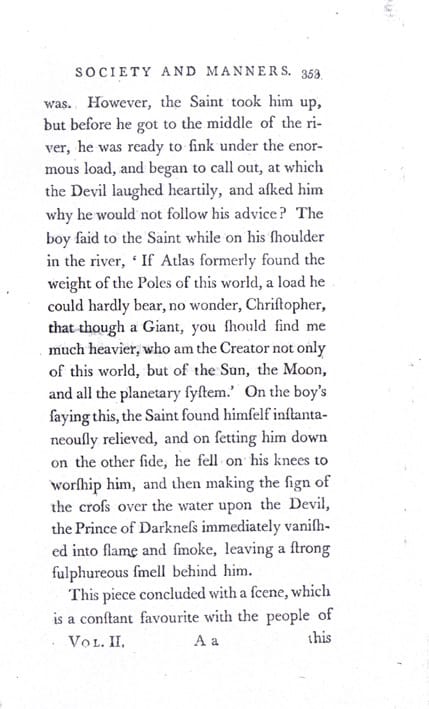
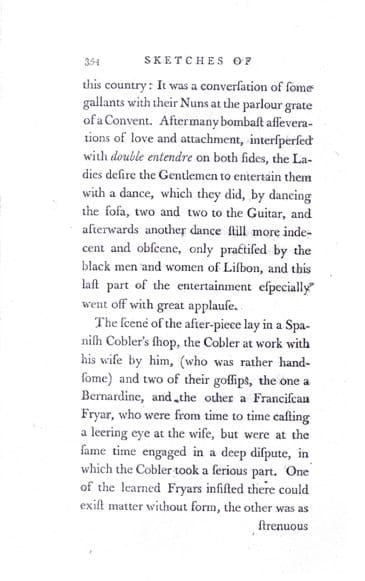
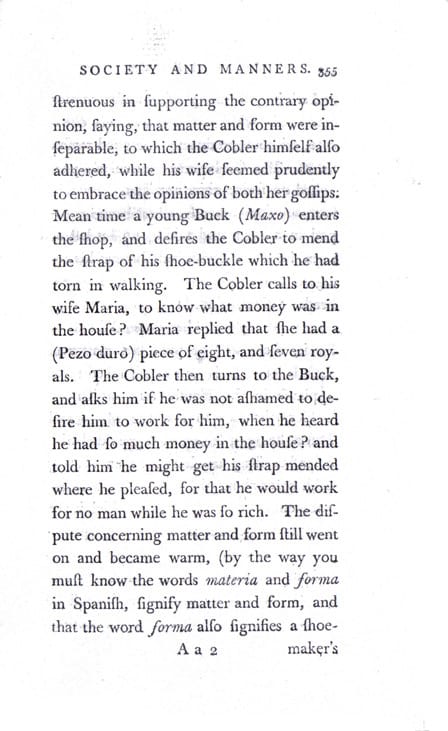
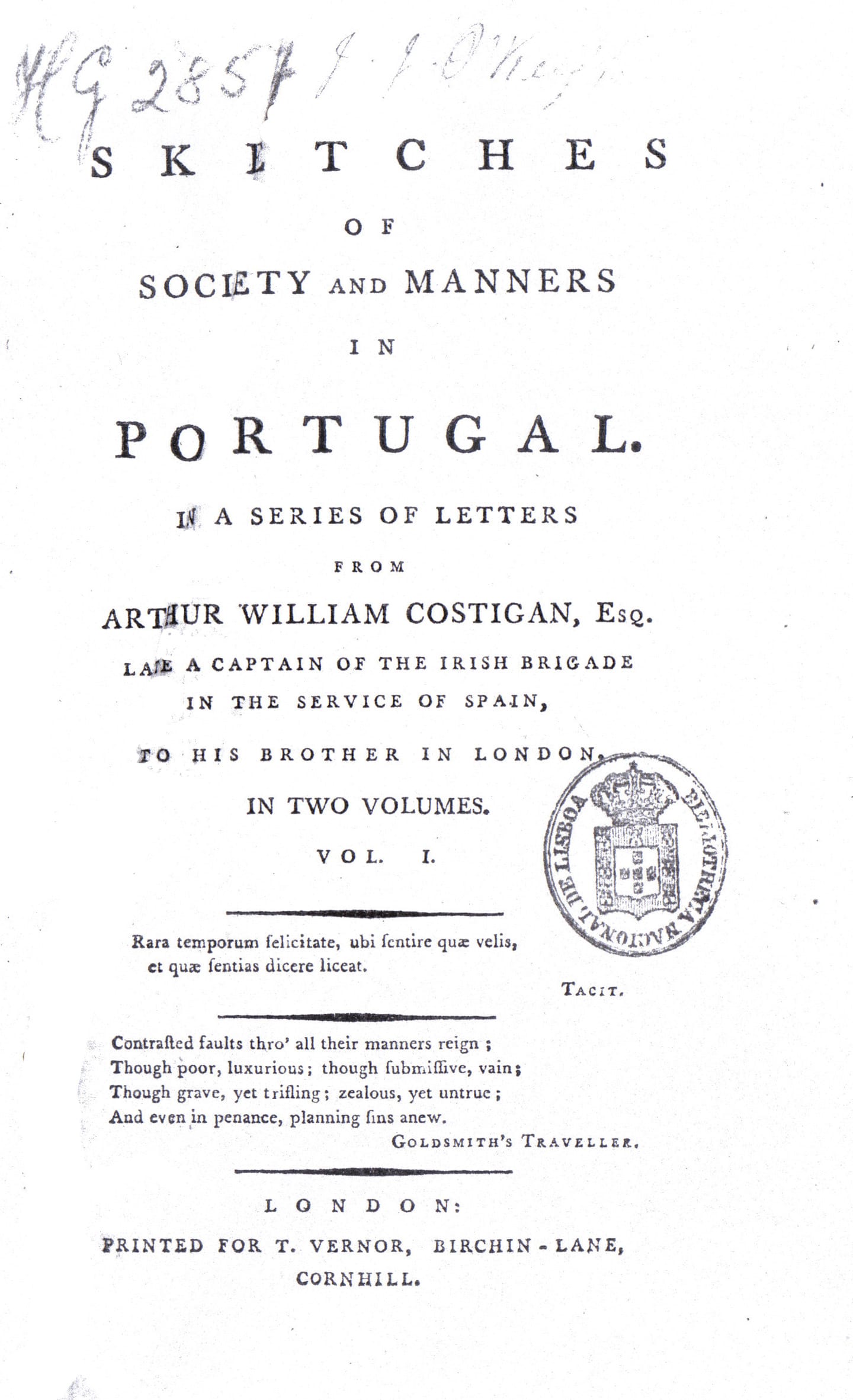
- Arthur William Costigan, Sketches of society and manners in Portugal, London, T. Vernor, 1788, Vol I (pp. 324-325); Vol II ( pp. 159-160; 336-337; 343-354; 375; 380/382)
- Menções
- Tradução em 1989: Cartas sobre a Sociedade e os Costumes de Portugal 1778-1779 (tradução, prefácio e notas de Augusto Reis Machado, Lisboa, Lisóptima (Vol. II pp. 149-158); Rui Vieira Nery
The lye direct being thus given to their most flagrant accusations, other methods of preventing the match were to be adopted, and I was positively assured one evening at the Opera, that I was to be set upon at going out. When I came to the door, a couple of fellows seemed inclined to prevent my passing, and were drawing their knives: I instantly started back, drew my sword, and pinned one of them to the wall,
the other made off, as well as several companions they had without. The vilain I secured proved to be a servant of the Almada familiy.
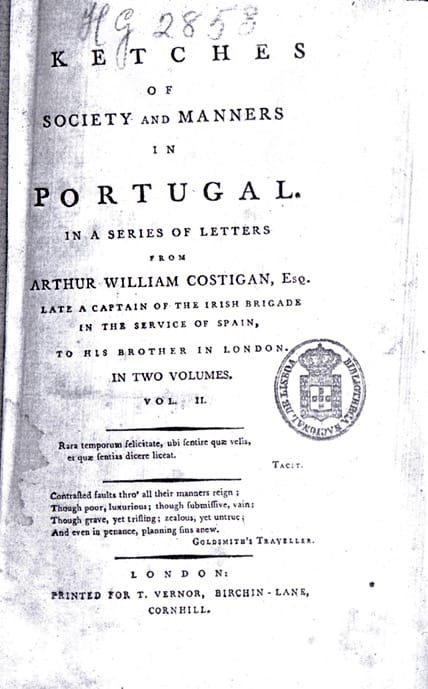
Sketches of society and manners in Portugal, London, T. Vernor, Vol II
[Um Notário de Lisboa descreve ao autor as conquistas amorosas de um Cristão Novo rico da capital, Bernardo Soares Mendes da Costa, desmentindo calúnias sobre a nobreza dos seus antepassados]
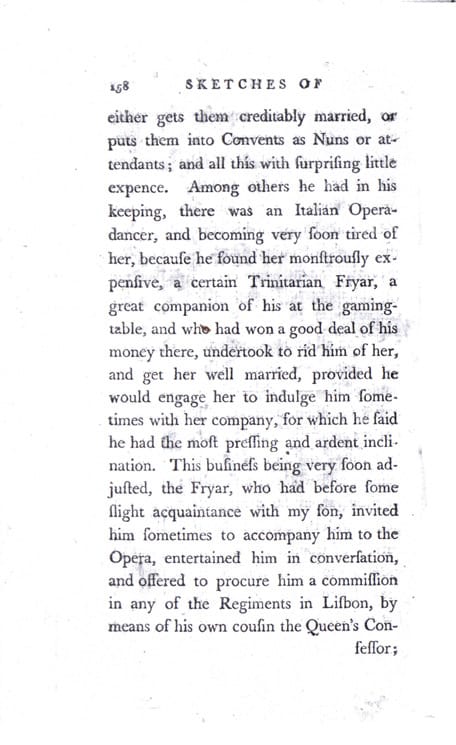
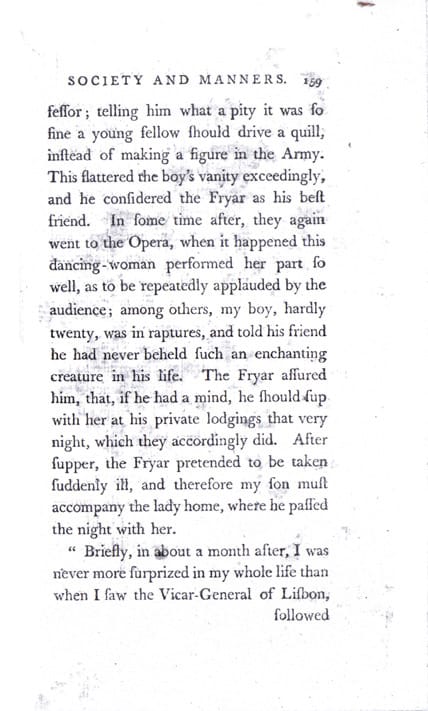
telling him what pity it was so fine a young fellow should drive a quill, instead of making a figure in the Army. This flattered the boy's vanity exceedingly, and he considered the Fryar as his best friend. In some time after, they again went to the Opera, when it happened this dancing-woman performed her part so well, as to be repeatedly applauded by the audience; among others, my boy, hardly twenty, was in raptures, and told his friend he had never beheld such an enchanting creature in his life. The Fryar assured him, that, if he had a mind, he should sup with her at his private lodgings that very night, which they accordingly did. Ater supper, the Fryar pretended to be taken suddenly ill, and therefore my son must accompany the lady home, where he passed the night with her.
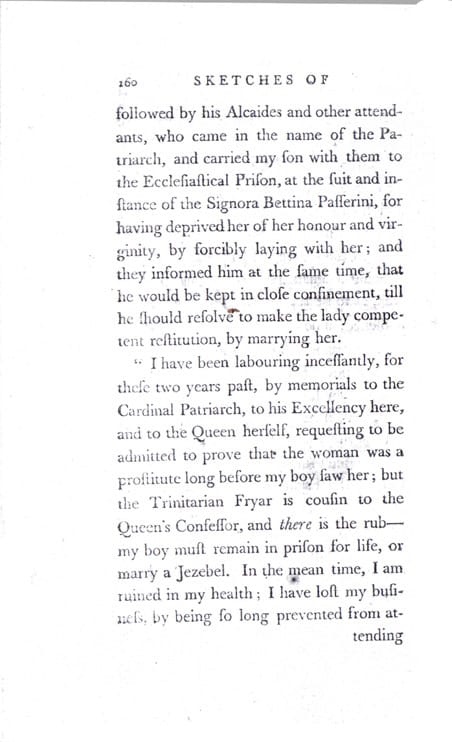
Briefly, in about a month after, I was never more surprized in my whole life than when I saw the Vicar-General of Lisbonfollowed by his Alcaides and other attendants, who came in the name of the Patriarch, and carried my son with them to the Ecclesiastical Prison, at the suit and instance of the Signora Bettina Passerini, for having deprived her of her honour and virginity, by forcibly laying with her; and they informed him at the same time, that he would be kept in close confinement, till he should resolve to make the lady competent restitution, by marrying her.
Letter XLI
Lisbon, 1779
Dear Brother
When I promised in a former letter to give you an account of a theatrical representation we had been present at, the evening which preceded all our confusion, I did no then imagined I should be able to join to it the account of a real farce I have seen performed by this whole Court since, which in ridicule and burlesque exceeds, in my opinion, everything the grossest of all farcical performances ever produced, in the grossests times, upon a theatre.
There is no public theatre here at present, the pious Queen not chusing to permit such a school of immorality in a public manner, much less would she suffer women to exhibit on the stage, were it open, being of opinion,
that permitting women thus to act in public, who have too much the appearance of patronizing the vice of her country; for the principal object is to obviate public scandal, as this agrees with what I have mentioned on former occasions, as well as with standing advice the old Fryars in this country are ever giving to the young ones, si non caste, tantum modo caute, 'if you cannot be chaste, at least be cautious.' Accordingly the wits here say har Majesty, by virtue of her absolute authority, may prevent the women from acting in public but, they thank God, it is not in her power to prevent them from playing their parts in private.
It was on occasion of the anniversary of a marriage that we were invited to dine, as well as the British Envoy and several other persons of note, at a Nobleman?s country house, about six miles from here, where there was a numerous company assembled. [...]
[...] But to return to the dramatical entertainment¾the theatre was neatly fitted up, but entirely in same taste with their Churches and Chapels, every thing was covered with crimson damask, the curtains and draperies were of the same stuff, and ornamented with a profusion of mock lace, both of gold and silver. A considerable deal more of company attended in the evening than we had seen at dinner, and the front rows of the boxes were full of Ladies, who looked charmingly, and seemed to be there in the proper point of view. Their hair was done up in a wonderful variety of plaits and braids, with a great degree of taste, and without caps, but a quantity of beautiful flowers, both natural and artificial, supplied their place, and were richly intermixed with sprigs of diamonds, besides many breast-knots. solitaires and pendants of the same and other precious stones. Lord Freeman looked everywhere for his
mistress, but she did not appear, though the family had been also invited; but on account of the disturbance Doctor Duncan raised that they had sent their excuse. The performers were mostly of the profession brought from Lisbon for the occasion, and our entertainment consisted of three parts: the first was a Portuguese comedy, intermixed with some very extraordinary singing; the second was a most uncommon medley, but which I understood better, as I had formerly seen something like it in a puppet show at Madrid; the last was called a Spanish farce, or Entremez, in which the actors attempted to speak Spanish, but did it wretchedly.
The performers had a way of drawling out their words, and speaking through the nose, so much more than I have perceived in ordinary conversation here, that I confess I lost much of the wit and salt of the first part, and even many of the sentences and the thread of the plot, if it had any. One thing I remarked was that the laugh
was chiefly kept up by the smut and repartees of an old woman, who was employed as a procuress, or go-between, and every time she opened her mouth was followed by with bursts of applause. One scene I particularly noticed was that where a young countryman, deeply smitten with the charms of one of the ladies of the piece, took to bed; the uncle, in great consternation, sends for a Physician who appears at the patient's bedside, feels his pulse and makes him put out his tongue, on which he makes some witty remarks, though not very decent. He afterwards asks the patient where his chief complaint lay? The patient replies that he has had violent pains in his stomach and bowels but that since he had a hearty sit of b-lch-g a little before, he was much easier. This indecent joke produced a hearty laugh. The Physician then asks the uncle what was the complexion of his nephew's urine? The old man begs his honour's pardon and tells him, as he was not book learned, he did not
understand the question. The other than bawls into the uncle's hear 'How is your nephew in regard to his p-s-ng?' A universal clap of applause with the repetition of Bravo! Bravo! announced how much the company were satisfied with this delicate sally of wit. But my eyes were particularly fixed upon Donna Gui[o]mar, a prodigious fat lady who sat immediately before me; I think I have never seen so corpulent a woman, who appeared to be so young, and I really expected she would have gone into convulsions with laughing on the occasion; with one hand she clapt a large fan she held in it on her face and with the other stuck in her side she laid back in the easy chair on which she sat under me; as I Stood behind her in the box, I saw her overgrown full neck which was uncovered and prevented from starting over by a large rising circumference of stays which opposed themselves heaving and undulating fro a long time like the waves of the sea after being agitated by a storm and which was to me a
proof she was perfectly well pleased with her entertainment.
The next scene presented us with the serpent tempting Eve to eat the apple, and, his Infernal Majesty the Prince of Darkness passed the most exagerated encomiums on her beauty, in order to engage her to eat, which, as soon as she had done, and had made Adam do the same, there came a terrible storm of thunder and lightning, in the midst of which we had a dance of Infernal spirits, with the Devil in the middle, all in high glee, and congratulating their Monarch on the success of his scheme against
mankind; the Devil was dressed in black, with scarlet stockings, long ruffles, the frill of his shirt, a broad lace on his hat, and a large feather in it, all of the same colour. While they were exceedingly well diverted with their dance, a voice from behind the stage pronounces, in a loud and solemn tone, the word JESUS, on which the whole company of Devils sunk immediately under the stage through trap-doors, from which flames and black smoke were seen rising, till they were shut. As soon as the scene was shifted, the Eternal Father was seen again descending, but now in great wrath and without any lights or angels attending him. He immediately called for Noah, who, it seems, was ready in waiting, telling him he was so provoked by the wickedness of mankind that he was resolved to drown them all together, and said he was heartily vexed that he had taken the trouble of creating such a set of ungrateful scurvy fellows. But here the piety of Noah interceded in their favour
and, at last, it was agreed that Noah should build an Ark, according to the directions the Eternal Father gave him; he therefore orders Noah to go to the King's dockyard in Lisbon and call John Gonçalves (which is the name of the present Master Builder here) whom he desired Noah to employ under his own inspection in the work assuring him he preferred John Gonçalves? method to those of all their boasted French and English Builders (this compliment to the nation produced a great clap of approbation from the audience) after which the Eternal Father went up again to Heaven and Noah to build his Ark.
Let no snarling French critic henceforth cavil with your Shakespeare for the irregularity of his historical plays, which only included the small period of twenty or thirty years, which vanish into a point when compared to the distance of time between this last and the following scene of our piece, which consisted of a conversation between
St. Christopher (a Giant), our Saviour, who was represented as a very pretty boy of about ten or twelve years old, but very poorly dressed, and the Devil, whom I readily knew again, having the same dress he appeared in before. The Devil complains grievously to the Saint of the irreparable mischief the coming of Christ had done to himself and his kingdom, said that he could now scarcely put down his foot on any corner of the Earth without meeting with Christians and Saints. He asked the Saint what sort of conscience his master had that he was for taking all to himself and would leave him nothing, though he must be sensible, it was much more the fear of him than any love for his antagonist that made so many Christians, and desired the Saint might introduce him to Christ, so that they might settle their affairs in an amicable manner? Saint Christopher replied he did not really know where to find Jesus Christ at present, but said he believed he was with his father and mother in the city of
Heliopolis, in Egypt. The Devil said he had not time to go far that night but that he thought the little boy the Saint had there with him very much resembled Jesus Christ to the best of his remembrance, when he saw him once , going to the Temple at Jerusalem. The Saint assured him he was not Christ and the little boy himself declared that so far from it he was only the son of a poor Carpenter of Nazareth who, with the sweat of his forehead, had a couple of pilchards and a bit of brown bread for himself and his mother to eat.
After this, St Christopher and the Devil had a long conversation upon the nature of the Trinity; and this last concluded, it was upon the whole such an intricate contradictory piece of business that he confessed he could not comprehend it. Upon this the Saint very familiarly tells the Devil he must be a great blockhead, (hum pedaço d'Asno)
a piece of an ass literally, for that nothing was more self-evident and intelligent, adding, that he would make it so even to him in an instant. On this he took up with his left hand the skirt of his own gown or habit, and making a fold of a part of it with his right, said, Here is one; then making another fold, said, Here are two; and making a third, asked him if that was not three? and the other answering in the affirmative, the Saint dropped the three folds and stretched out all that part of his garment in one piece between his hands, without folds; and the Devil, after such a palpable demonstration, now acknowledged that he clearly understood the nature of the Trinity.
This matter being discussed, the little boy begged St. Christopher to carry him on his shoulder over a deep and rapid river running close by them, to which the Saint consented, though the Devil cautioned him how he meddled with that little boy, of whom he still had his doubts as to he really
was. However, the Saint took him up, but before he got to the middle of the river he was ready to sink under the enormous load and began to call out, at which the Devil laughed heartily and asked him why he would not follow his advice? The boy said to the Saint while on his shoulder in the river, ?If Atlas formerly found the weight of the Poles of his world a load he could hardly bear, no wonder, Christopher, that though a Giant you should find me heavier who am the Creator not only of this world but of the Sun, the Moon and all the planetary system?. On the boy?s saying this, the Saint found himself instantaneously relieved and on setting him down on the other side he fell on his knees to worship him, and then making the sign of the cross over the water upon the Devil, the Prince of Darkness immediately vanished into flame and smoke, leaving a strong sulphurous smell behind him.This piece concluded with a scene, which is a constant favourite with the people of
this country: It was a conversation of some gallants with their Nuns at the parlour grate of a Convent. After many bombast asseverations of love and attachment, intersperced with double entendre on both sides, the Ladies desire the Gentlemen to entertain them with a dance, which they did, by dancing the fofa, two and two to the Guitar, and afterwards another dance still more indecent and obscene, only practised by the black men and women of Lisbon, and this last part of the entertainment especially went off with great applause.
The scene of the after-piece lay in a Spanish Cobler?s shop, the Cobler at work with his wife by him (who was rather handsome) and two of their gossips, the one a Bernardine and the other a Franciscan Friar who were from time to time casting a leering eye at the wife, but were at the same time engaged in a deep dispute in which the Cobler took a serious part. One of the learned Friars insisted there could exist matter without form, the other was as
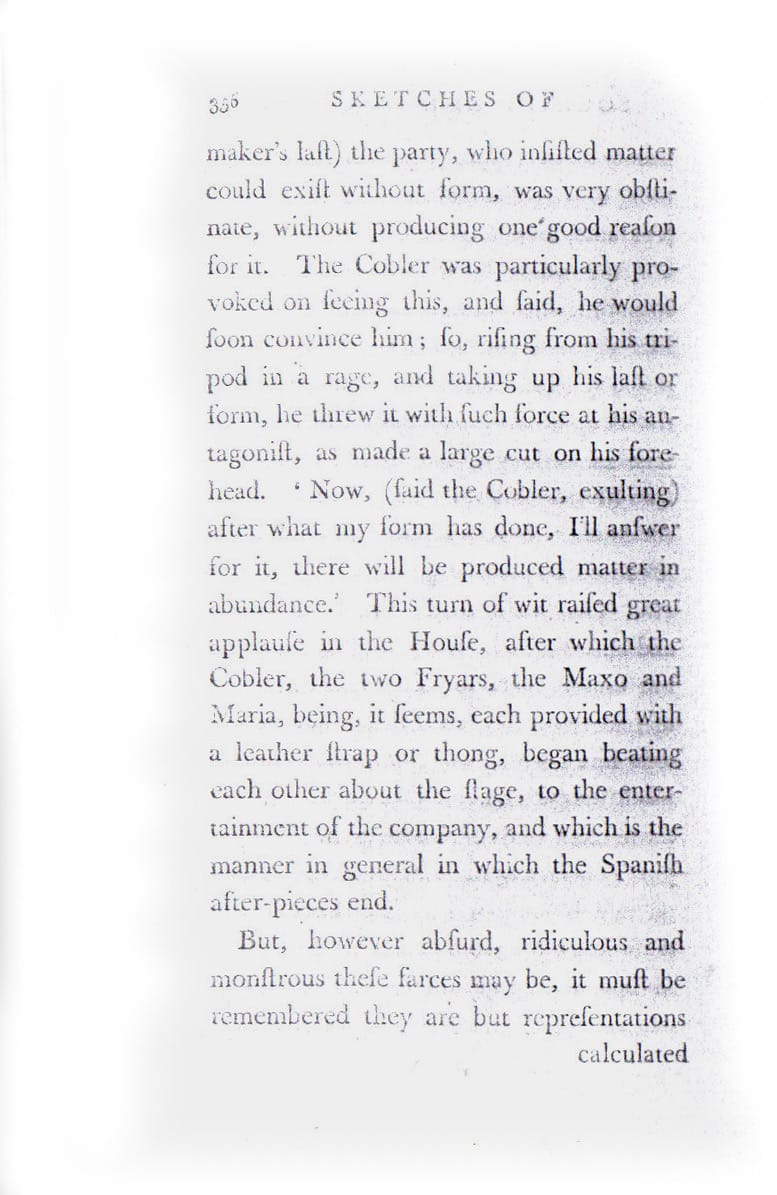
strenuous in supporting the contrary opinion, saying that matter and form were inseparable, to which the Cobler himself also adhered, while his wife seemed prudently to embrace the opinions of both her gossips. Mean time a young Buck (Maxo) enters the shop and desires the Cobler to mend the strap of his shoe-buckle which he had torn in walking. The Cobler calls to his wife Maria to know what money was in the house? Maria replied that she had a (Peso duro) piece of eight, and seven royals. The Cobler the turns to the Buck and asks him if he was not ashamed to desire him to work for him, when he heard he had so much money in the house? and told him he might get his strap mended where he pleased for that he would work for no man while he was so rich. The dispute concerning matter and form still went on and became warm (by the way you must know the words materia and forma in Spanish signify matter and form, and the word forma also signifies a
shoemaker laft) the party, who insisted matter could exist without form, was very obstinate, without producing one good reason for it. The Cobler was particularly provoked on seeing this and said he would soon convince him; so, rising from his tripod in a rage and taking up his laft or form he threw it with such force at his antagonist as made a large cut on his forehead. ?Now (said the Cobler, exulting) after what my form has done, I?ll answer for it, there will be produced matter in abundance?. This turn of wit raised great applause in the House, after which the Cobler, the two Friars, the Maxo and Maria, being, it seems, each provided with a leather strap or thong, began beating each other about the stage, to the entertainment of the company, and which is the manner in general in which the Spanish after-pieces end.
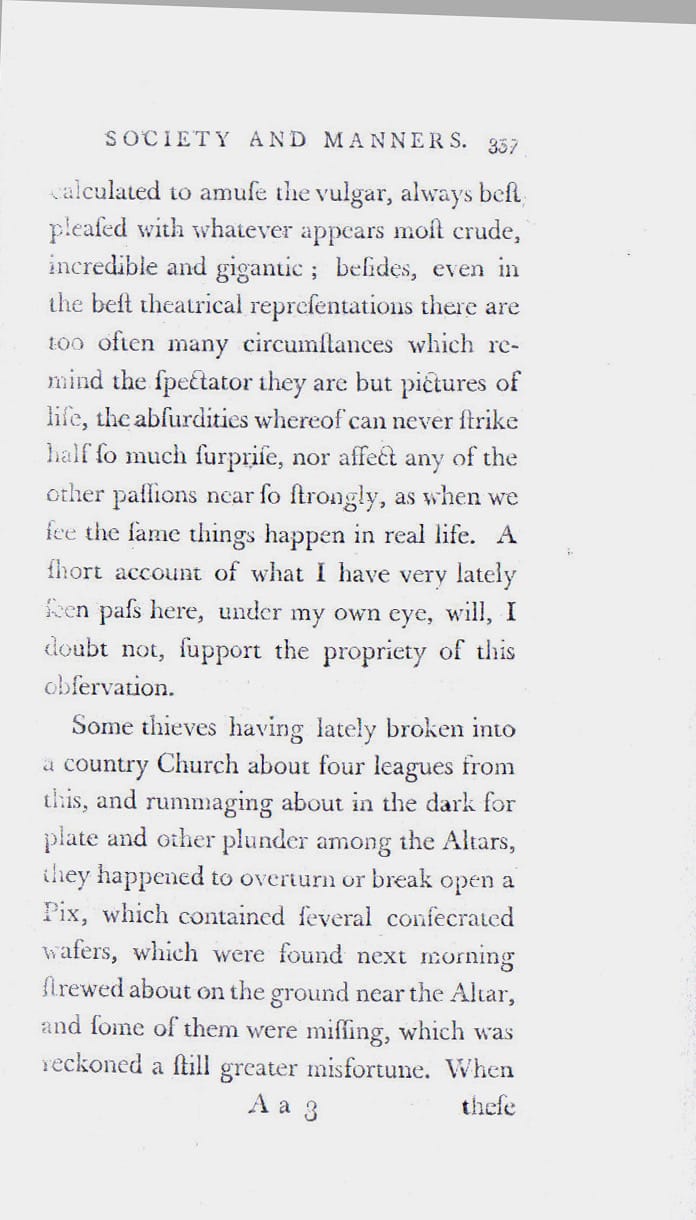
calculated to amuse the vulgar, always best pleased with whatever appears crude, incredible and gigantic; besides, even in the best theatrical representations there are too often many circumstances which remind the spectator they are but pictures of life, the absurdities whereof can never strike half so much surprise nor affect any of the other passions near so strongly as when we see the same things happen in real life. [...]
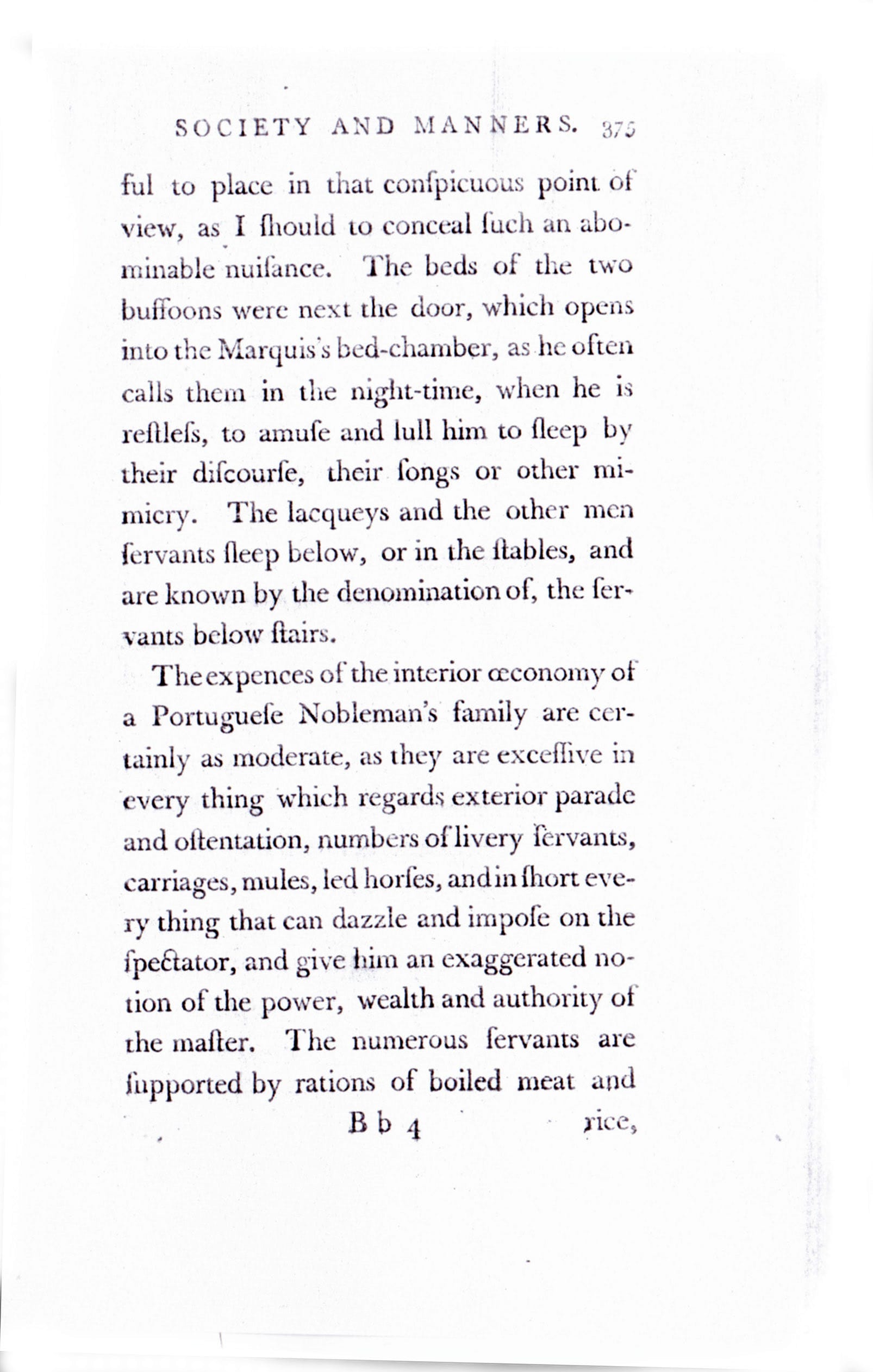
The beds of the two buffoons were next the door, which opens into the Marquis' bed-chamber, as he often calls them in the night-time, when he is restless, to amuse and lull him to sleep by their discourse, their songs or other mimicry. [...]
During dinner we had very fine pieces of David Perez's music well executed, and some charming arias by the best voices from the Patriarchal Church. At the Dessert, to which we removed into the adjoining Saloon, the same music was continued. One half of the servants attended us to the Dessert, while the other and graver part sat down to dinner at the table we left.
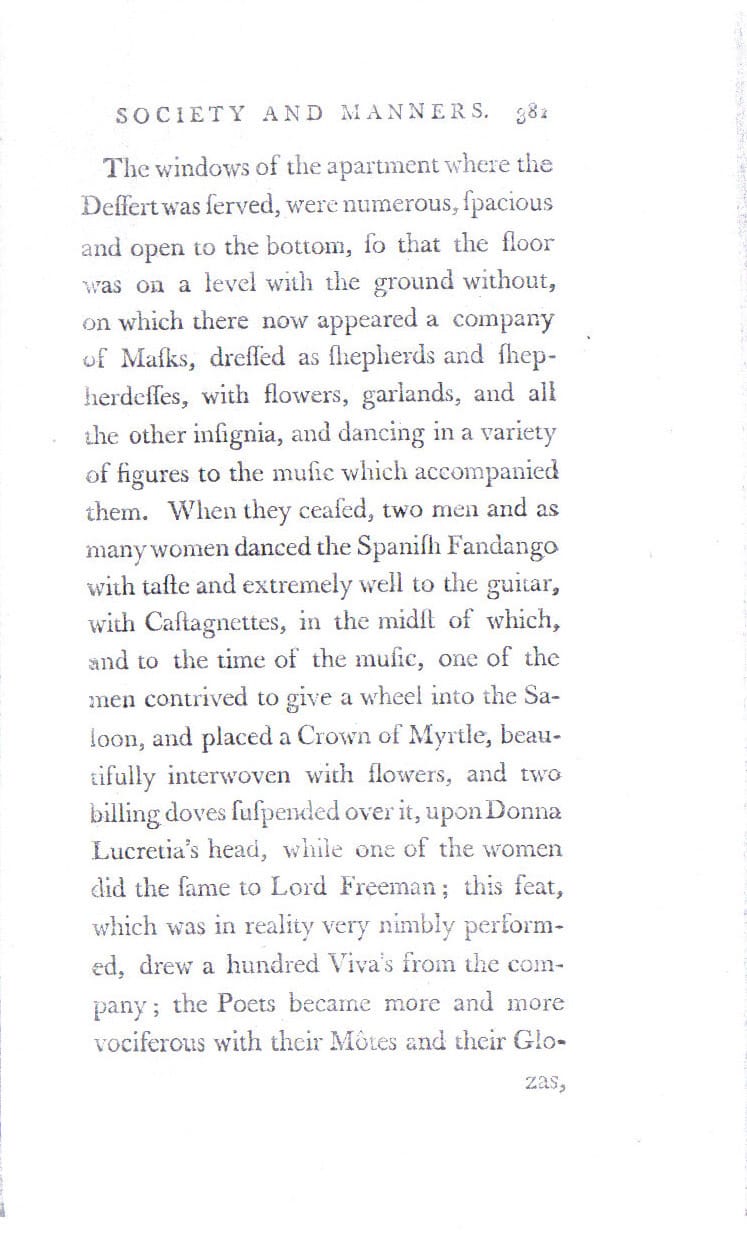
The windows of the apartment where the Dessert was served, were numerous, spacious, and open to the bottom, so that the floor was on a level with the ground without, on which there now appeared a company of Masks, dressed as shepherds and shepherdesses, with flowers, garlands, and all the other insignia, and dancing in a variety of figures to the music which accompany them. When they ceased, two men and as many women danced the Spanish Fandango with taste and extremely well to the guitar, with Castagnettes, in the midst of which, and to the time of the music, one of the men contrived to give a wheel into the Saloon, and placed a Crown of Myrtle, beautifully interwoven with flowers, and two billing doves suspended over it, upon Donna Lucretia's head, while one of the women did the same to Lord Freeman; this feat, which was in reality very nimbly performed, drew a hundred Viva's from the company; the Poets became more and more vociferous with their Môtes and their
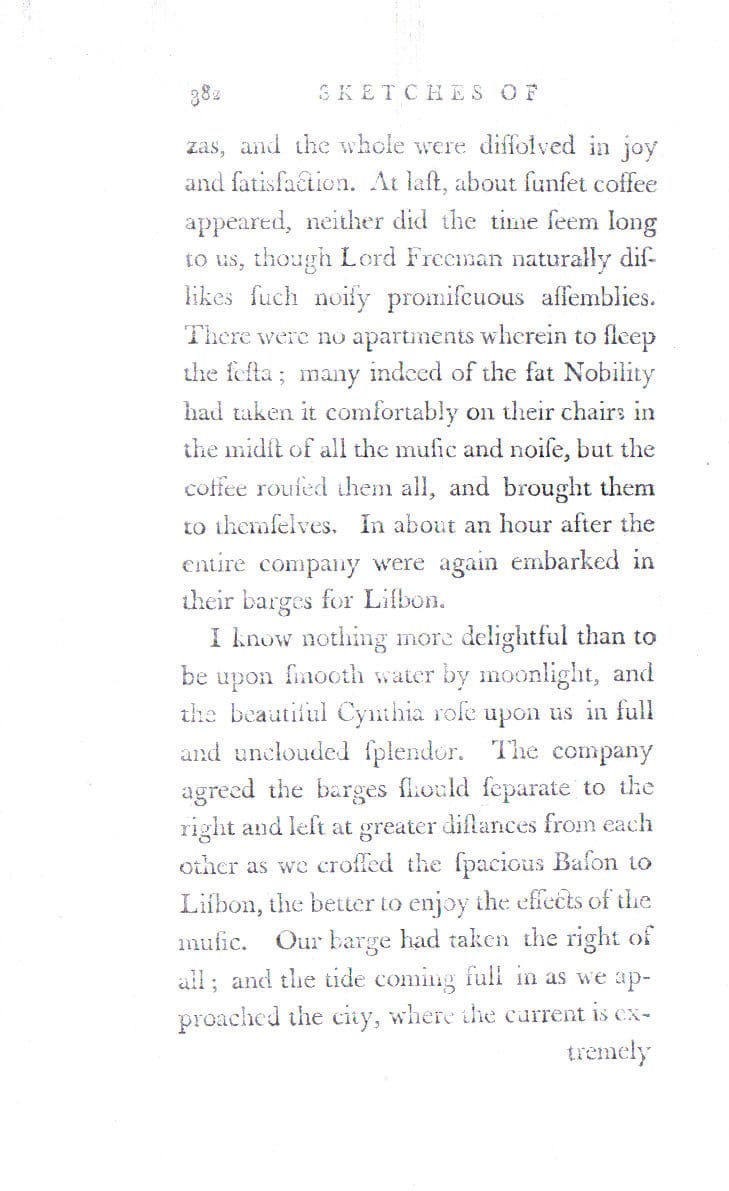
Glozas, and the whole were dissolved in joy and satisfaction. At last about sunset coffee appeared, neither did the time seem long to us, though Lord Freeman naturally dislikes such noisy promiscuous assemblies. There were no apartments wherein to sleep the sesta; many indeed of the fat Nobility, had taken it comfortably in their chairs in the midst of all the music and noise, but the coffee roused them all, and brought them to themselves. In about an hour after the entire company were again ambarked in their barges for Lisbon.
I know nothing more delightful than to be upon smooth water by monlight, and the beautiful Cynthyia rose upon us in full and unclouded splendour. The company agreed the barges should separate to the right and left at greater distances from each other as we crossed the spacious Bason to Lisbon, the better to enjoy the effects of the music.

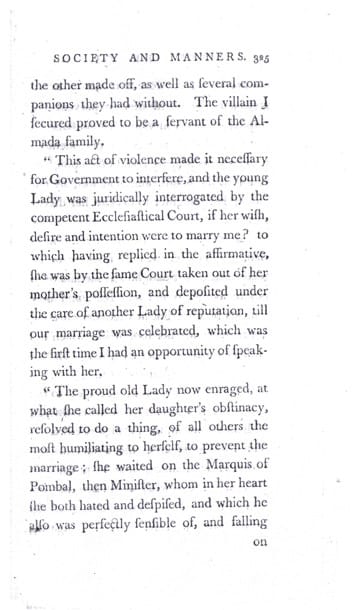

Tendo sido assim revelada a clara mentira das suas acusações mais flagrantes, era-lhes necessário adoptar outras formas de evitarem o casamento, e garantiram-me absolutamente, uma noite na Ópera, que iria ser assaltado à saída. Quando cheguei à porta, havia um par de indivíduos que pareciam inclinados a tentar evitar a minha passagem e que sacaram das facas: imediatamente dei um salto para trás, desembainhei a espada e espetei um deles contra a parede,
enquanto o outro fugia, juntamente com vários outros companheiros que tinham no exterior. O vilão que agarrei era um criado da família Almada.
Sketches of society and manners in Portugal, London, T. Vernor, Vol II
[Um Notário de Lisboa descreve ao autor as conquistas amorosas de um Cristão Novo rico da capital, Bernardo Soares Mendes da Costa, desmentindo calúnias sobre a nobreza dos seus antepassados]
dizendo-lhe que era uma pena ver um rapaz tão bem posto manusear uma pena em vez de fazer figura no Exército. Isto lisongeou muito a vaidade do rapaz, que passou a considerar o frade o seu melhor amigo. Algum tempo depois voltaram à Ópera, numa ocasião em que essa bailarina desempenhou tão bem o seu papel que foi repetidamente aplaudida pelo público e, entre outros, pelo meu rapaz, que estava deslumbrado e que disse ao amigo que nunca tinha visto criatura tão encantadora na sua vida. O frade garantiu-lhe que, se assim o desejasse, poderia cear com ela no seu apartamento nessa mesma noite, e assim se passou. Depois da ceia o frade fingiu ter adoecido subitamente, pelo que o meu filho teve de acompanhar a Senhora a casa, onde passou a noite com ela.
seguido dos seus Alcaides e de outros subordinados, que, em nome do Patriarca, levou o meu filho para a Prisão Eclesiástica, por queixa da Signora Bettina Passerini de ele a ter privado da sua honra e virgindade forçando-a a dormir com ele; e informaram-no, ao mesmo tempo, de que seria mantido em prisão rigorosa até se resolver a oferecer à Senhora em questão uma reparação adequada, casando com ela.
Carta XLI
Lisboa, 1779
Meu querido irmão
que consentir às mulheres exibir-se desta maneira em público, pareceria patrocinar o vício favorito do país, visto constituir a principal preocupação evitar o escândalo. Isto confirma o que já disse em tempos, assim como concorda com o conselho que os velhos frades, neste país, dão sempre aos novos: Si non caste tantum modo caute; se não podeis ser casto ao menos sede cauteloso. Em conformidade com estas razões, Sua Majestade, mercê da sua autoridade absoluta, pode proibir às mulheres de representarem em público; elas, porém, agradecem a Deus o não poder ela impedir de representarem em particular.
Por ocasião do aniversário de um casamento, fomos convidados a jantar com o enviado inglês e várias pessoas de categoria, na casa de campo de um fidalgo, situada a cerca de seis milhas de Lisboa. Eram muitos os convivas.[...] Mas para voltarmos ao divertimento dramático: o Teatro estava impecavelmente decorado, mas totalmente segundo o mesmo gosto que caracteriza aqui as igrejas e capelas; tudo estava coberto de damasco carmesim, e as cortinas e panejamentos eram do mesmo tecido e estavam ornamentados com abundância com uma imitação de renda, tanto de ouro como de prata.A frequência do sarau era consideravelmente superior à que tínhamos visto no jantar, e as filas da frente dos camarotes estavam cheias de Senhoras que olhavam de maneira encantadora e pareciam estar ali no melhor ponto para serem vistas.; os seus cabelos estavam dispostos com gosto em tranças que variavam até ao infinito; não tinham toucas, mas muitas e belas flores, naturais e artificiais, substituíam-nas, ricamente entremeadas de pregos de diamantes; traziam laços, solitários e brincos semelhantes. O Lord Freeman buscava por toda a aparte a sua
amante, que, afinal, não apareceu, apesar de a família também ter sido convidada. Mas em virtude do distúrbio, o doutor Duncan alvitrou que tivessem enviado as suas desculpas.
Os actores eram na sua maioria profissionais idos de Lisboa, e o espectáculo compunha-se de três partes. A primeira era uma comédia portuguesa, de mistura com alguns cantos; a segunda uma amálgama extravagante de coisas burlescas e sérias, e a última uma farsa espanhola ou entremez, em que os actores tentavam falar espanhol, mas muito mal.
era sobretudo provocado pela cara pintada e as respostas prontas de uma velha, que representava uma alcoviteira, e cada vez que ela abria a boca, ouvia-se uma trovoada de aplausos. Reparei principalmente na seguinte cena: um jovem camponês, profundamente atingido pelos encantos duma das damas da peça, adoeceu a ponto de ter de estar de cama; o tio, muito aflito, manda chamar um médico, que comparece junto da cama do doente, toma-lhe o pulso e observa-lhe a língua, sobre a qual faz algumas considerações engraçadas, mas não muito decentes. Pergunta depois ao doente onde se sente pior. Este responde-lhe que teve dores violentas no estômago e nas entranhas, mas depois de ter arrotado muito sente-se melhor.
percebe a pergunta. Outro, então, grita aos ouvidos do tio: - Como é a mija do seu sobrinho? Estrugem palmas e aplausos, mostrando quanto o público estava satisfeito com esta graça delicada.
indicava que se divertia imenso.
A peça que se seguiu era mais fácil de perceber, e continha maior número de cenas representativas de acções importantes. Começava pela criação do mundo; vimos o Pai Eterno, com uma grande barba branca, descer numa nuvem, iluminada por numerosas luzes, com anjos em volta a dar ordens para a Criação do Mundo. Sobre a cabeça tinha um triângulo equilátero, como emblema da Trindade.
o género humano. O diabo estava vestido de preto com meias escarlates, punhos compridos, uma camisa de bofes, um largo galão dourado no chapéu e uma pena da mesma cor que as meias. Durante a dança, uma voz saiu dos bastidores, pronunciou num tom forte e solene a palavra Jesus; logo o diabo e o seu séquito desapareceram por alçapões, donde, até se fecharem, se viu sair um fumo negro e chamas.
e ficou resolvido construir ele uma arca, segundo as instruções dadas pelo Pai Eterno. Ordenou então a Noé de ir aos estaleiros do rei, em Lisboa, de chamar João Gonçalves (que é agora mestre construtor) e de o encarregar dessa obra sob a sua inspecção, assegurando-lhe que preferia o método de João Gonçalves ao de todos os, tão gabados, construtores franceses e ingleses. Este elogio à nação produziu grandes aplausos. O Pai Eterno regressou aos céus e Noé foi ter com João Gonçalves.
S. Cristóvão (gigante), o nosso Salvador, representado como um rapazinho de dez a doze anos, mal vestido, e o diabo, que reconheci porque tinha o mesmo fato com que já tinha aparecido. O diabo queixa-se, amargamente, ao santo, do prejuízo irreparável que o nascimento de Cristo lhe causou a ele e ao seu reino, pois que, agora, não pode pôr os pés num canto da terra que não encontre logo cristãos e santos. Pergunta a S. Cristóvão que espécie de consciência tem o seu senhor, que puxa tudo para ele, e não lhe deixa nada, ainda que deva notar que é mais o medo do diabo do que o amor de Jesus que produz tantos cristãos. Pede em seguida ao santo para o pôr em contacto com Cristo, a fim de chegarem amigavelmente a um ajuste. S. Cristóvão responde que não sabe onde se encontra Jesus Cristo naquele momento, mas julga que deve estar com o pai e a mãe na cidade de
Heliópolis, no Egipto. O diabo replica que não tem tempo de ir tão longe esta noite, mas julga que a criancinha, que acompanha o santo, se parece muito com Jesus, quanto ele pode lembrar-se, pois o viu, de longe, há 700 anos, quando ia ao templo de Jerusalém. O santo assegura que essa criança não é Cristo, e a criancinha declara ela mesma, que, longe de ser o Cristo, não é senão filho dum pobre carpinteiro de Nazaré, que, com o suor do seu rosto, dificilmente ganha o necessário para comprar duas sardinhas e um bocado de pão escuro, para se sustentar a ele e à mãe.
que não havia nada mais evidente, acrescentando que num instante lha ia explicar. Pegou então com a mão esquerda na manga do fato e, fazendo-lhe uma dobra com a direita, disse: - Aqui tem uma; depois, fazendo outra prega: Aqui tem duas; e por fim, fazendo uma terceira, perguntou se não faziam três. O diabo respondeu afirmativamente, e o santo deixou desfazerem-se as três pregas e esticou, com as mãos, essa parte do fato, de forma a mostrar um só pedaço e sem pregas; e o diabo, depois duma demonstração tão palpável, reconheceu que percebia claramente o mistério da Trindade.
todavia, o santo pôs a criança às costas; mas antes de ter alcançado o meio do rio, quase ia caindo, tal era a enormidade do peso, e começou a pedir socorro; o diabo desatou a rir às gargalhadas, e perguntou-lhe se, para a outra vez, não seguiria o seu conselho. A criança, às costas do santo, no meio da água, disse-lhe: - Se para Atlas o peso do Mundo era um fardo que mal podia suportar, não é de espantar, Cristóvão, ainda que sejas gigante, que me aches muito mais pesado, eu que sou o Criador, não só deste Mundo, mas do sol, da lua e de todo o sistema planetário. Ditas estas palavras, o santo sentiu-se imediatamente aliviado, e depois de ter posto a criança do outro lado da água, caiu de joelhos e adorou-a. Fazendo depois o sinal da cruz ao diabo, o príncipe das trevas esvaiu-se em chamas e fumo, ficando um forte cheiro de enxofre.
uma conversação de algumas freiras com os seus galãs, no locutório de um convento. Depois de muitos protestos de amor e de dedicação, de mistura com palavras de duplo sentido, de parte a parte, as damas pediram aos homens de as regalar com uma dança, o que eles fizeram. Dois actores dançaram a fofa, enquanto dois outros tocavam guitarra; dançaram uma outra dança ainda mais indecente, que está em uso entre os pretos e pretas de Lisboa, e sobretudo esta última parte do espectáculo arrancou grandes aplausos.
entusiasmo sustentava a opinião contrária, dizendo que a matéria e a forma eram inseparáveis; o sapateiro era desta opinião, enquanto a mulher parecia adoptar, prudentemente, a opinião dos dois frades. Um rapagão entrou em seguida na loja e pediu ao sapateiro para lhe consertar a tira da fivela dum sapato, que tinha rasgado quando andava. O sapateiro chamou a mulher e perguntou-lhe que dinheiro havia em casa. - Uma moeda de 87 réis (peso de ouro), respondeu ela. Então o sapateiro, voltando-se para o rapaz, perguntou-lhe se ele não tinha vergonha de o convidar a trabalhar para ele, quando lhe diziam que tinha tanto dinheiro em casa, que podia ir mandar consertar as suas correias onde quisesse, mas que ele é que não trabalharia para ninguém enquanto fosse tão rico. A disputa entre a matéria e a forma recomeçou então, e tornou-se acalorada (notai que as palavras materia e forma, em espanhol, significam matéria e forma e a palavra forma significa também
forma de sapateiro). O partido que sustentava que a matéria podia existir sem forma, tornava-se muito obstinado sem apresentar nenhuma razão de peso, pelo que o sapateiro zangou-se e disse que o ia convencer; levantando-se então do seu tripé, e agarrando na forma, deitou-a com tanta força à cabeça do seu antagonista que lhe fez um buraco na testa. - Olhe, exclamou o sapateiro, rindo, depois do que a minha forma acaba de fazer, garanto que produzirá matéria em abundância. Esta facécia provocou aplausos, e em seguida, os dois frades, o rapaz e a mulher do sapateiro, armados cada um duma correia, começaram a bater uns nos outros, com grande gáudio do público. É em geral assim que acaba a maior parte das peças espanholas.
calculados para divertir o povo, que prefere sempre o que se afigura mais grosseiro, inverosímil e também grandíloquo. Além de que, até nas piores representações teatrais há também muitas vezes algumas circunstâncias que lembram ao espectador que se trata apenas de quadros da vida, cujas absurdidades não podem verdadeiramente impressionar, nem imitar qualquer paixão, como quando vemos as mesmas cenas passarem-se na vida real. [...]
As camas dos dois bobos ficavam perto da porta que dá para o quarto de dormir do Marquês, visto que ele os chama frequentemente durante a noite, quanto não tem sono, para o divertirem ou o fazerem adormecer com o seu discurso, as suas canções ou outras momices [...]
Ao longo do jantar tivemos diversas belas peças de Música de David Perez bem executadas, e algumas árias encantadoras pelas melhores vozes da Igreja Patriarcal. À sobremesa, para a qual nos fizeram passar ao salão contíguo, continuou a mesma Música. Uma parte dos criados seguiu-se para nos servir a sobremesa, enquanto a outra - a mais solene - se sentava a jantar à mesa de que nos tínhamos levantado.
As janelas da sala em que a sobremesa foi servida eram numerosas e desciam até abaixo, de forma que o chão estava ao mesmo nível do piso exterior, onde apareceu nesse momento um grupo de mascarados, vestidos de pastores e pastoras, com flores, grinaldas e todas as restantes insígnias, e dançando segundo uma variedade de figurações ao som da Música que os acompanhava. Quando terminaram, dois homens e outras tantas mulheres dançaram o Fandango espanhol, com bom gosto e muito bem, ao som da guitarra e com castanholas, no meio do que, sempre ao ritmo da Música, um dos homens conseguiu rodopiar pelo salão adentro e colocar uma coroa de murta, lindamente entretecida com flores, sobre a cabeça de D. Lucrécia, enquanto uma mulher fazia o mesmo a Lord Freeman; este feito, que foi, na realidade, executado com muita habilidade, provocou uma centena de ?vivas? dos presentes; os poetas tornaram-se cada vez mais loquazes com os seus motes e
glosas, e todos estavam derretidos em alegria e satisfação. Por fim, à hora do pôr do sol, apareceu o café, mas o tempo não nos custou a passar, apesar de a Lord Freeman naturalmente desgradarem estas assembleias promíscuas e barulhentas. Não havia quartos para se dormir a sesta; na verdade, muitos dos fidalgos gordos tinham-na já dormido confortavelmente nas suas cadeiras, por entre a Música e o ruído, mas o café despertou-os a todos e fê-los cairem em si mesmos. Em cerca de uma hora já todo o grupo estava de novo a bordo das barcas para o regresso a Lisboa. Não sei de nada de mais delicioso do que estar à superfície calma das águas ao luar, e a bela Cíntia ergueu-se sobre nós num esplendor pleno e sem nuvens.O grupo decidiu que as barcas se deveriam separar para a direita e para a esquerda, a maior distância umas das outras, enquanto atravessávamos a extensa bacia, em direcção a Lisboa, de maneira a apreciarmos melhor o efeito da Música.